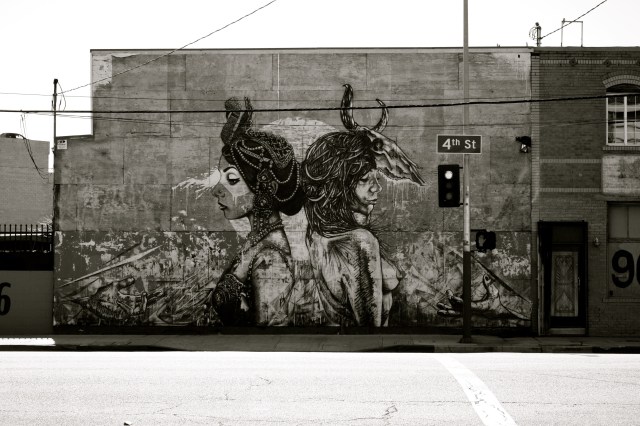
 This essay follows Black culture in the United States through the lens of gangsta rap. This musical art functions as a window into the hidden consciousness of post-industrial, working class, African American society. To listen to the legendary lyrics of individuals like Ice-T and Tupac Shakur is to tap in to an expansive network of political actions and ultimately recognize gangsta rap as a form of resistance. But to understand how music can become a literal weapon, we must first acknowledge the history of these warriors.
During a recent discussion at the University of California, Los Angeles, professor Robin Kelley ended his talk about contemporary Black culture in America with a quote from Dr. King: “the ultimate logic of racism is genocide.” Kelly continues to explain how the use of the word genocide speaks to the “many ways” people of color are being killed in today’s society.
In 1944 Raphael Lemkin introduced the term genocide to describe the destruction of artifacts and culture. Genocide does not refer to the direct murder of a nation or ethnic group,
“It is intended rather to signify a coordinated plan of different actions aiming at the destruction of essential foundations of the life of national groups, with the aim of annihilating the groups themselves.” (80)
Evidently, the racism directed towards African American’s in the U.S. extends beyond the killing of innocent bodies; it is also about social death – about cultural destruction and domination. Thus, both King and Kelly are calling on us to engage in revolutionary activity that defends and honors African American art and culture. As artists who not only subvert the status quo, but also put form to what others may only know as visceral feelings, gangta rappers provide vivid accounts of what it means to be Black in America, and in doing so, take part in a strong and sustainable form of resistance.
While it is easy to overlook the words and behaviors of rappers as marginal in relation to larger, organized political movements, these dynamic forms of expression are in fact legitimate avenues of political action. As members of a particular pocket of Black America, gangsta rappers place the experience of African Americans squarely within the context of a racist and negligent society. In his novel Race Rebels, Robin Kelly explains how gangsta rap and the lifestyle it exemplifies is a foundational component of organized action and as such is critical to the fight to end African American genocide.
Organized or not, resistance takes many forms. History books ensure familiarity with the widely revered actions of heroic individuals such as Rosa Parks or Dr. King. The “public transcript” of such leaders has been taken as representative of the Black community as a whole. Yet, the unorganized resistance of the black working-class, such as provocative music, loud talking, cursing, spitting, and petty theft are in fact what inform many organized movements, and thus should be seen as explosive forms of black working-class political action. Few mediums highlight this as well as gangsta rap.
West Coast gangsta rap originated in late 1980’s California during a time of devastating structural changes in the urban economy. The rappers themselves came of age amidst harsh economic displacement, deindustrialization, social dismantlement and the militarization of cities like Compton, Watts, and other predominantly Black communities in the L.A. area. Thus their music, as an observation of the world around them, mirrors racist social and political practices that dictate their every day decisions.
The rappers themselves have been dubbed street tellers, pimp narrators, hustler poets, even living echoes of their cities due to the ways in which their lyrics allow listeners to follow gangsterism – particularly criminal activity and rugged individualism – directly to mainstream American culture.
Ice–T // Escape From the Killing Field:
“No one wants to
Live in an urban war
You live there cause
Your parents were poor
They live there because
Theirs were also”
It is through these rhythmic narratives that rappers illustrate how the economic policies and social actions in capitalist L.A. constrict the decisions and overall potential of African American youth. One way of resisting this lack of opportunity is to exaggerate the stereotypes that popular society imposes upon Black culture, which in turn substantiates the deliberately oppressive forces that posit black lives.
Ice Cube // A Bird in the Hand:
“Sorry, but this is our only room to walk
Cause we don’t want to drug push
But a bird in the hand, is worth more than a Bush”
Appropriating the gangsta, thug or pimp personas is one way of amplifying the racial neglect. Through appropriation, rappers demonstrate resistance by recasting and reconstructing dominant stereotypes in order to remake their own sense of identity.
Ice–T: “When rap came out of L.A., what you heard initially was my voice yelling about South Central. People thought, ‘That shit’s crazy,’ and ignored it. Then NWA (the rap group Niggas With Attitude) came and yelled, Ice Cube yelled about it. People said, ‘Oh that’s just kids making a buck.’ They didn’t realize how many niggas with attitude there are out on the streets. Now you see them.” (Race Rebels, 184)
Through their music, rappers are rejecting white, normative notions and instead
providing evidence of their own agency and ability to represent themselves. This unique, radical response is based on the freedom to articulate ones own identity. Evidently, gangsta rap music is a politics of recognition – a rejection of dehumanization and a discrediting of mainstream media’s attempt to define the Black working class.
While it does often include rather extreme individualism, gangsta rap ultimately represents a collective strategy to challenge authority and the ruthless exploitation of capitalism. The challenging of popular discourse through a creative expression of identity is a strategy of resistance because it paints a picture of an inverted world in which the victims are in control. This inversion of what has been so deeply naturalized penetrates deep into dominant ideologies, highlighting racist abandonment, as well as capitalist exploitation. For instance, to preach replacing an insufficiently low-paying job at McDonalds with drug peddling is to advocate an attack against capitalism. Similarly, valuing crime as a mode of survival and a form of rebellion moves blame for unemployment and low wages away from the poor and unemployed and onto the people and institutions that control their lives, specifically politicians and police.
Other rappers openly accuse America of stealing land, facilitating the drug trade, and waging large-scale, international ‘drive-by shootings’ against other countries. In their eyes, true gangsterism is typified most by the state itself, not by Black inner-city youths.
W.C: “Well, the suit is running the world, that’s the real gangsta right there.” (Race Rebels, 202)
But rather than a cry of grief, this oral poetry acts as a witness to the unimaginable, as well as evidence that some of the most powerful forms of resistance are rooted in art, not in organized politics. In applying the gangster metaphor to the state, gangsta rappers exemplify another comment Kelley made during his talk at UCLA: “Violence is not the product of protestors; rather it is a product of the state.”
Despite this empowering reversal of blame, both mockery and disrespect have been central components of Black vernacular culture, and there is no denying the violence and misogyny of gangsta rap music. In this sense, much of rap music supports mainstream American values, including polarized gender roles, rampant heterosexism and homophobia, and the eroticization of capitalist consumption. Yet, when we place the violence and misogyny of gangsta rap within the historical context of post-industrialism and class separation, we see that violence and sexual repression tend to surface in communities among men whose limited access to resources jeopardizes their claim to a gendered position of power. In other words, the highly violent and offensive sexual politics of gansta rap can also be seen as the social and political struggle for the remasculation of African American men. I am not excusing this widely offensive behavior, rather I am suggesting that rap lyrics shed light on the social reality induced by racist social practices and institutions.
Overall, gangta rap music transforms both brutal and mundane chaos into the vivid and significant, rendering the African American genocide inescapably palpable to the global community. This form of creative expression forces us to question not only what we have normally considered as resistance, but also as political, and in doing so, center the margins on previously hidden stories that have been ignored by popular culture.
Moreover, as listeners, it is our duty to honor these forms of expression. As Ice T puts it, we should all “check the pulse of the rhyme flow,” because the power of rap is limitless. This power rests in rap’s ability to articulate the hidden transcripts of Black culture in the United States and share the beliefs, values, worldviews, and aspirations of African American youth. This multifaceted, diverse, and complicated oral tradition unveils hidden discourses, challenges the status quo, turns ordinary street talk into a national discussion and ultimately shapes the politics of the Black movement. Gangta rap is a flashpoint of creative expression and political defiance. But above all, gangsta rap shows us that the things often deemed least important to our survival – music, poetry, vernacular – are the very things that keep us alive.
 Jessica Merino