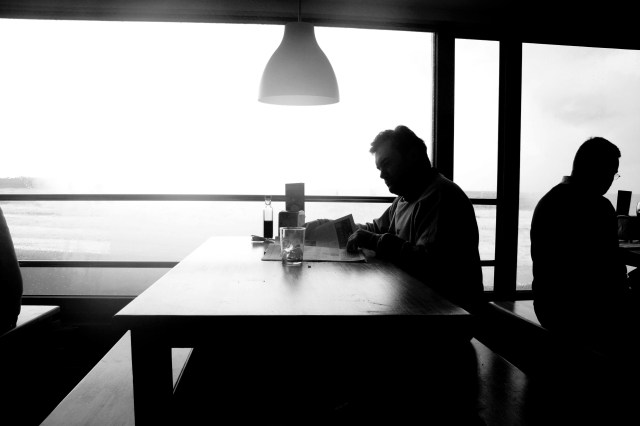
 The sky was open and the smell of spring was hitching a ride upon the wind. Nature had gathered around my window as it does every morning, waiting patiently for my rise. I was eager to release my subconscious self and greet the redwood trees, but an unbearably bright light kept me from opening my eyes. The sun’s gentle rays were overpowered by beams of electric fluorescence that blistered at my eyelids. I rolled restlessly from side to side, frustrated and scared, trapped in a never-ending slumber.
One week has now passed since this frightful morning, and the harshness of this experience still burns deep in my mind. Why was I so afraid of light, a universal symbol of life, love and truth? How could a habitually life-affirming image bring me such immense fear and anxiety? I have come to believe that subconscious experiences like dreams and seemingly mysterious emotions are tied to past experiences, and that life and death are intimately connected.
My father died when I was eight years old. I missed three days of school, or maybe it was three weeks – I’m not too sure. I wanted to cry at his funeral, but I couldn’t. I felt emotionless, desensitized, exhausted. One by one, each condolence and empty “I’m sorry” lowered me further and further into a state of numbness.
A decade after his sudden death, the absence of my father finally hit me. And for three years I have been going in and out of waves of sorrowful disconnection – periods where I grow indifferent to the world, unresponsive to people in my life, afraid of new friendships and of signs of love and light. I feel the glow of good friends by my sides, I smell fresh rain as it glistens by my feet, and I know opportunity is illuminating the horizon, yet the light somehow brings me fear.
In reading Tuck Everlasting, the passage about Winnie “almost remember[ing] something pleasant, something soothing, that would never quite come up to the surface of her mind” (106), helped me realize that we remember in ways that we do not know. Our bodies and souls are made up of and profoundly connected to the most subtle and delicate experiences, beginning with our first moment in the warmth of our mothers’ wombs. Thus, feelings of loss and love, of sorrow and joy, of pleasure and pain, of light and darkness, all evoke memories of my father, regardless of whether or not I consciously link them to him
Recently I was lying on the chest of a man with whom I’ve grown very close. The rise and fall of his chest, the friendly tickle of his hair, the warmth of his skin – together these sensations catapulted me into a deep déjà vu, a borderline psychedelic experience, within which I was overwhelmed by the rapid surfacing of a submerged memory. Yet the memory never fully broke through. I never saw the image of myself lying on my fathers chest, but I knew in my heart and in my bones that I had been there before, in the same cocoon of love and comfort.
This experience has made me think that there may not be that great of a difference between life and death. In his Theoretical Perspectives on Death Anxiety, Kastenbaum mentions, “on the unconscious level, we do not have the concept of negation, so there is no death to cancel out life” (23). This helps me understand why, sometimes, the closer I am to death, the more life I feel and why sometimes, when I feel the love of my partner, I am reminded of the death of my father.
I know that my father loved me very much, that he hugged me and kissed me every day, that he lifted me up into the sky and spun me around in circles until I begged to be put down. I remember the way he carefully combed the knots out of my hair after I got out of the shower, only to mess it up with a towel and send me into a fit of laughter.
It’s remembering this love that makes me cry. It’s remembering the feeling of his sweaty forehead beneath my fingertips as I sat on his shoulders. It’s the image of his eyes locking mine from behind his orange-lensed sunglasses whenever I looked off the soccer field. It’s the smell of the pancake batter he poured onto the back of his hand in the shape of a burn mark to scare my stepmom.
When I reminisce over these moments from years ago, I am overwhelmed by the depth and breadth of emotions that wash over me. Today I can handle these emotions and appreciate the color they bring to my life. This class has helped me make sense of these memories and the emotions they trigger, as well as mysterious dreams and the peculiar sensations of almost remembering. These experiences are signs that my life is but a continuation of what my father left inside me.
Thus, life and death are inextricable linked, and their entwinement is what forms the soul of beauty, of art and of human existence. Perhaps those blurred moments, those times when we can’t quite tell life from death, reality from dream, present from past, are in fact gentle works of art, as well as signs that death brings forth boundless life.
————————————————————————–
Where does the feeling of ‘almost remembering’ come from? What does it mean to remember something without ever knowing it existed in the first place?
Recently I was lying on the chest of a man with whom I’ve grown very close. The rise and fall of his chest, the friendly tickle of his hair, the warmth of his skin – together these sensations catapulted me into a deep déjà vu, a borderline psychedelic experience, within which I was overwhelmed by the rapid surfacing of a submerged memory.
Yet the memory never fully broke through, although there was no denying the visceral feeling of familiarity, of almost remember, of yes, I’ve been here before.
Perhaps this sensation is the subconscious mind’s way of revealing our profound connection to things we do not know exist, like the feeling of your father’s first embrace or the slow, soothing undulation of your grandmother’s old rocking chair.
These subconscious memories, which dance somewhere between the wildly estranged and the faintly familiar, seem to be built less on recollection and more so on nature – on our most subtle and delicate experiences. Perhaps, with time, each experience becomes a part of a pattern deeply ingrained in our genome. Thus, when we experience something consistent with a past experience, our entire body – every bone, blood vessel and tissue – begins tingling with remembrance.
 Jessica Merino